SC upholds ‘right to die’ for man in vegetative state
Why in the News?
The Supreme Court’s judgment is in the news because it represents a landmark moment in India’s legal and medical history. It is significant for the following reasons:
- First Implementation of 2018 Guidelines: This is the first time the Supreme Court has actually applied its own 2018 Constitution Bench judgment that recognised “passive euthanasia” and laid down guidelines for it.
- Upholding the Right to Die with Dignity: The court affirmed that the right to life under Article 21 includes the right to die with dignity, specifically allowing the withdrawal of life-sustaining treatment for a person in a persistent vegetative state (PVS).
- Human Interest Element: The case involves a 32-year-old man, Harish Rana, who has been in a vegetative state for 13 years, and his family’s agonising decision to seek permission to let him “leave with dignity.”
Background
Harish Rana suffered severe head injuries and 100% quadriplegic disability after a fall from a building in 2013. For nearly 13 years, he has been in a persistent vegetative state, kept alive through Clinically Assisted Nutrition and Hydration (CANH). His family, who have cared for him throughout, approached the Supreme Court seeking permission to withdraw this life support. The legal framework for this request was established by a 2018 Constitution Bench judgment of the Supreme Court, which recognised “passive euthanasia” (withdrawing life support) and laid down guidelines for it. This case is the first practical test of those guidelines.
Features
- The Judgment: A Bench of Justices J.B. Pardiwala and K.V. Viswanathan allowed the withdrawal of CANH for Harish Rana.
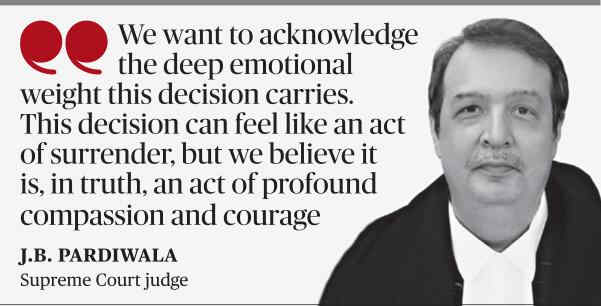
- Compassionate Language: The court delivered the judgment with deep empathy for the family, acknowledging their “profound compassion and courage” and stating that allowing Harish to “leave with dignity” reflects their “selfless love.” The court noted that the family only resorted to legal action after reaching “a point of no return.”
- Role of AIIMS: The court directed AIIMS Delhi to shift Harish Rana from his residence to their palliative care centre to oversee the process.
- Focus on Palliative Care: The judgment firmly linked the withdrawal of life support to a “well-structured, tailored, robust and articulated palliative care plan.” It emphasised that the patient must be looked after sensitively, with dignity as the foremost concern.
Challenges
- Ethical and Moral Dilemmas: Cases like these force society to confront difficult questions about the sanctity of life versus the right to die with dignity. For families, the emotional weight of such a decision is immense, as acknowledged by the court.
- Lack of Clear Legal Framework: While the 2018 judgment provided guidelines, India still lacks a comprehensive law on euthanasia and advance medical directives. Each case may currently require legal scrutiny, which can be a long and painful process for families.
- Medical and Palliative Care Infrastructure: The judgment’s emphasis on palliative care highlights a significant challenge: India’s healthcare system has limited palliative care facilities and expertise. Ensuring that patients in similar situations receive sensitive, dignified end-of-life care is a major hurdle.
- Defining “Point of No Return”: Determining medically and legally when a patient has reached a “point of no return” where withdrawal of life support is ethical remains a complex challenge requiring collaboration between doctors, families, and the judiciary.
Way Forward
- Enacting Comprehensive Legislation: There is a need for Parliament to enact a clear and compassionate law on passive euthanasia and advance medical directives to provide a statutory framework, reducing the need for families to approach the Supreme Court in every case.
- Strengthening Palliative Care: The government must invest in expanding palliative care infrastructure, training medical professionals, and creating protocols for end-of-life care across the country, as emphasised by the court.
- Public Awareness: It is crucial to create societal awareness about the legal and medical options available, including the concept of living wills and the right to die with dignity, to empower individuals and families to make informed decisions.
- Clear Medical Protocols: Medical councils should work to establish clear, standardised protocols for determining PVS and for the process of withdrawing life support, ensuring consistency and ethical rigour.
Conclusion
This Supreme Court judgment is a profound and humane step in affirming that the right to life includes the right to a dignified death. By allowing Harish Rana’s family to withdraw life support, the court has not only implemented a 2018 legal principle but has also shown deep compassion for a family’s decade-long ordeal. The judgment rightly links the act of “letting go” with the provision of sensitive palliative care. However, it also underscores the urgent need for India to develop a robust legal and medical framework for end-of-life decisions, ensuring that the dignity of every individual is protected until the very end.