Walking on footpath is a fundamental right, says SC
Why in the news?
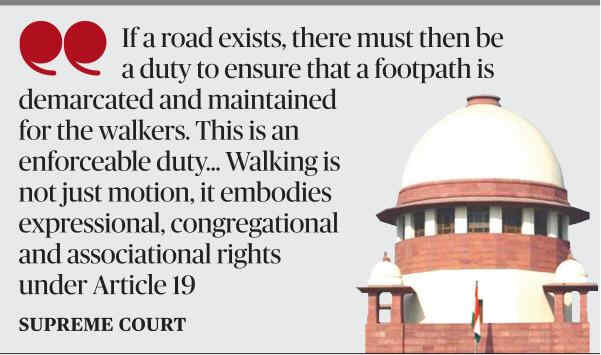
Recently, the Supreme Court, in its historic judgment written by Justice P.S. Narasimha, held that the right to walk in safety along marked and well-maintained footpaths falls within the ambit of the Fundamental Right guaranteed by Article 19(1)(d) (Right to Freedom of Movement). This judgment came in the wake of a case where the child aged five years died when he was struck down by a truck while he was accompanying his father to his school.
Background
- Article 19(1)(d) guarantees freedom of movement throughout India.
- Urbanisation and motorisation have prioritised vehicles over pedestrians, leading to:
- Encroached or absent footpaths.
- Unsafe walking conditions.
- High numbers of pedestrian fatalities.
- The Motor Vehicles Act, 1988, focuses largely on vehicular regulation and does not explicitly recognise pedestrian rights.
Walking has historical and constitutional significance, being linked to:
- Freedom of expression [Article 19(1)(a)].
- Right to assemble [Article 19(1)(b)].
- Right to association [Article 19(1)(c)].
- Right to life and dignity under Article 21.
Feature
Recognition of Walking as a Fundamental Right
- Walking on safe, demarcated footpaths is part of the constitutional guarantee of free movement.
- The right of pedestrians takes precedence over the privilege of motorised vehicles.
Duty of Authorities
- Wherever roads exist, authorities have an enforceable duty to provide and maintain footpaths.
- Municipal bodies are responsible for ensuring pedestrian safety.
Need for Legislative Framework
- The Court called for:
- A dedicated statute recognising pedestrian rights.
- Mechanisms for quick grievance redressal.
- Institutional arrangements for implementation.
Proposal for Regulatory Body
- Establishment of a full-time regulator with domain expertise.
Functions:
- Planning pedestrian infrastructure.
- Enforcement and monitoring.
- Ensuring accessibility and safety.
Directions to the Government
- Ministry of Housing and Urban Affairs.
- Ministry of Rural Development.
- Ministry of Road Transport and Highways.
Challenges
Infrastructure Deficit
- Lack of continuous and accessible footpaths.
- Encroachments by vendors, parked vehicles, and utilities.
Vehicle-Centric Urban Planning
- Roads designed primarily for motorised traffic.
- Pedestrian needs often ignored.
Weak Institutional Coordination
- Multiple agencies share responsibility without clear accountability.
Inadequate Legal Protection
- No dedicated legislation for pedestrian rights.
Poor Enforcement
- Illegal parking and encroachments remain unchecked.
Accessibility Concerns
- Absence of ramps, tactile paving, and facilities for elderly and disabled persons.
Resource Constraints
- Urban local bodies often lack financial and technical capacity.
Way Forward
Enact a Pedestrian Rights Law
- Recognise walking as a statutory and enforceable right.
- Define duties and liabilities of authorities.
Create a National Pedestrian Authority
- Coordinate planning, implementation, and monitoring.
- Set standards for pedestrian infrastructure.
Adopt Complete Streets Approach
- Roads should accommodate pedestrians, cyclists, and public transport users alongside vehicles.
Strengthen Urban Local Bodies
- Increase funding and technical support for municipalities.
Universal Accessibility
- Ensure barrier-free infrastructure under the Rights of Persons with Disabilities Act, 2016.
Smart and Sustainable Mobility
- Promote walkability and non-motorised transport under initiatives such as:
- Smart Cities Mission.
- AMRUT.
- Transit-Oriented Development policies.
Public Awareness and Enforcement
- Strict action against encroachments and unsafe driving.
- Encourage a culture that respects pedestrian rights.
Conclusion
The Supreme Court’s verdict is an important step away from the vehicle-oriented approach towards a people-oriented vision for urban mobility. The right to walk, as a basic human right, underscores that public spaces are meant for use by pedestrians and motorists alike. Proper implementation through legislation, institutional measures, and urban planning makes Indian cities safe, accessible, and ecologically sustainable