India’s Goods Exports Hit Record $45.2 Billion in May
Why in the News?
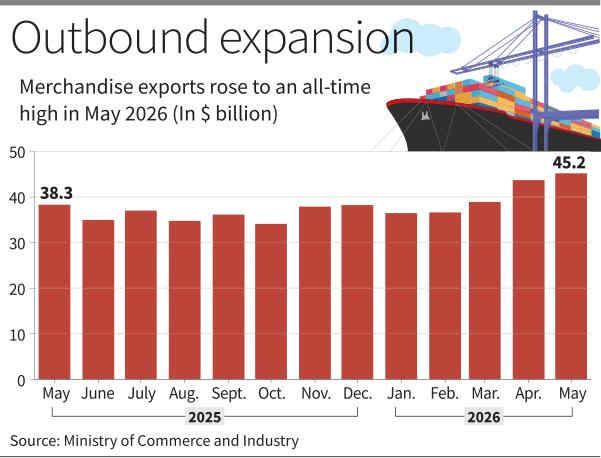
India’s merchandise exports reached a record high of $45.2 billion in May 2026, registering an 18% year-on-year increase. However, despite strong export growth, the country’s trade deficit widened to $10.5 billion because imports of goods and services increased even faster.
Background
- Exports are goods and services sold by India to other countries, earning foreign exchange.
- Imports are goods and services purchased from abroad.
- The trade deficit occurs when the value of imports exceeds the value of exports.
- A rising export sector is generally positive for economic growth, employment, and foreign exchange earnings, but a widening trade deficit can create pressure on the balance of payments and currency stability.
| Indicator | Indicator | Growth |
| Merchandise Exports | $45.2 billion | +18% |
| Services Exports | $36.8 billion | +13.2% |
| Merchandise Imports | $73.4 billion | +22.1% |
| Services Imports | $19.1 billion | +14.1% |
| Overall Trade Deficit | $10.5 billion | Up from $6.8 billion |
Feature
Record Merchandise Exports
- Highest-ever monthly goods exports at $45.2 billion.
- Reflects strong external demand and improved competitiveness.
Broad-Based Growth
- Growth was not limited to one sector; multiple industries contributed:
| Sector | Export Value | Growth |
| Engineering Goods | $12.3 billion | +24.5% |
| Electronic Goods | $5.1 billion | +11.6% |
| Chemicals | $2.7 billion | +12.7% |
| Gems & Jewellery | $2.5 billion | +6.7% |
Challenges
Rising Trade Deficit
- Merchandise trade deficit increased to $28.2 billion.
- Imports grew faster than exports.
Dependence on Imports
- India continues to rely heavily on imports of:
- Crude oil
- Electronics components
- Machinery
- Precious metals
Global Economic Uncertainty
- Geopolitical tensions
- Supply-chain disruptions
- Slowing growth in major economies
Services Import Growth
- Services imports increased by 14.1%, adding pressure on the overall trade balance.
Currency and External Sector Risks
- A sustained trade deficit can:
- Increase pressure on the rupee.
- Raise external financing requirements.
- Affect foreign exchange reserves if not offset by capital inflows.
Way Forward
Boost Manufacturing Competitiveness
- Expand Production-Linked Incentive (PLI) schemes.
- Improve productivity and technological capabilities.
Diversify Export Markets
- Reduce dependence on traditional markets.
- Increase exports to Africa, Latin America, and Southeast Asia.
Promote High-Value Exports
Focus on:
- Electronics
- Semiconductors
- Pharmaceuticals
- Green technologies
- Engineering products
Reduce Import Dependence
- Strengthen domestic production of critical inputs.
- Encourage import substitution in strategic sectors.
Improve Trade Infrastructure
- Modernise ports and logistics.
- Reduce export transaction costs.
- Enhance the ease of doing business.
Leverage Trade Agreements
- Utilise Free Trade Agreements (FTAs) with partners such as the U.K., UAE, and Australia.
- Negotiate new market-access arrangements.
Conclusion
The high level of merchandise exports of Rs 45.2 billion in May 2026 indicates that the export performance of India has become diversified, particularly in engineering products, electronics, and chemicals. However, since the rate of imports has increased even more rapidly, there has been an increase in the trade deficit. The sustained performance in exports, along with market diversification, will be necessary to achieve healthy trade-led growth.