SC status ‘only for Hindus, Buddhists, Sikhs’
Why in the News?
The Supreme Court of India recently ruled that the Scheduled Caste (SC) status is exclusive to persons professing Hinduism, Buddhism, or Sikhism. In the case of Chinthada Anand vs. State of Andhra Pradesh, the Court held that conversion to any other religion (specifically Christianity or Islam) results in the immediate and complete loss of SC status from the moment of conversion. The judgment reaffirmed the strict interpretation of the Constitution (Scheduled Castes) Order, 1950, dismissing a plea by a Christian convert who sought protection under the SC/ST (Prevention of Atrocities) Act, 1989.
Background
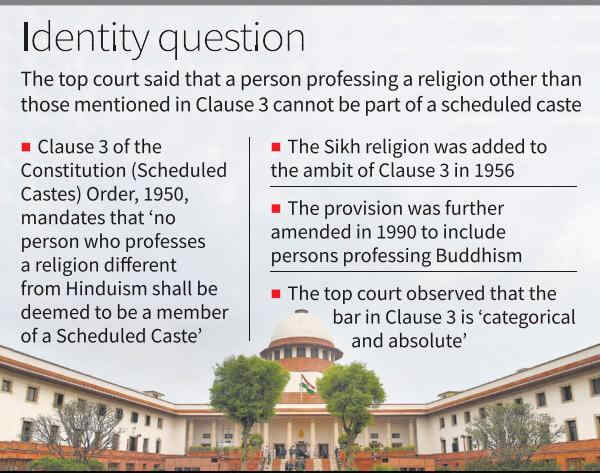
- Constitutional Framework: The Constitution of India, under Article 341, empowers the President to specify castes, races, or tribes deemed to be Scheduled Castes in a state. The Constitution (Scheduled Castes) Order, 1950, initially limited SC status to Hindus.
- Amendments via Presidential Orders: Through subsequent amendments (1956 and 1990), the benefits were extended to Sikhs and Buddhists, acknowledging that these religions historically shared the social stigma of caste-based untouchability despite their doctrinal rejection of it.
- The Petitioner’s Case: Chinthada Anand, born into a Hindu Madiga (SC) community, converted to Christianity to become a pastor. He filed a complaint under the SC/ST (PoA) Act, 1989, alleging caste-based attacks and slurs.
- High Court Ruling: The Andhra Pradesh High Court quashed the proceedings, ruling that since Anand professed Christianity, a religion that does not recognise caste, he could not claim the protections afforded to SCs.
Key Features of the Supreme Court Judgment
- Strict Interpretation of Clause 3: The Bench invoked Clause 3 of the 1950 Order, which states that “no person who professes a religion different from Hinduism shall be deemed to be a member of a Scheduled Caste.” The Court held that this bar is “categorical and absolute.”
- Meaning of ‘Profess’: The Court clarified that ‘profess’ implies a public declaration and outward manifestation of faith, not merely private belief. It was observed that Christianity’s theological foundation does not incorporate the institution of caste.
- Loss of Status: Conversion to any religion other than Hinduism, Sikhism, or Buddhism leads to an immediate and complete loss of SC status, irrespective of birth or continued social stigma.
- Conditions for Re-conversion: For converts seeking to revert to Hinduism, Sikhism, or Buddhism, the Court laid down a three-pronged test:
- Proof of Caste: Clear proof of the original caste.
- Bona Fide Reconversion: Credible evidence of genuine reconversion.
- Acceptance: Satisfactory evidence that the original community has accepted and assimilated the individual back into the fold.
- Distinction from STs: The judgment noted a distinction for Scheduled Tribes (STs). Unlike SCs, the ST Order (1950) does not prescribe a religion-based exclusion. However, if a tribal member abandons tribal customs and assimilates into another religion’s practices, their tribal identity becomes a factual question to be determined at trial.
Challenges
- Continuity of Social Stigma: A key criticism is that caste is a social reality, not merely a religious one. Converts often continue to face caste discrimination, untouchability, and social ostracism even after conversion. Denying them legal protection ignores the persistence of caste-based violence.
- Violation of Article 25 (Freedom of Religion): Critics argue that the judgment indirectly penalises religious conversion. The fear of losing constitutional protections (reservations and legal safeguards) acts as a coercive element, potentially violating the fundamental right to freely profess, practice, and propagate religion.
- Erosion of Legal Safeguards: By excluding Christian and Muslim converts from the SC/ATROCITIES Act, the judgment creates a vulnerable class of citizens who, despite belonging to historically oppressed communities, are left without statutory protection against caste-based atrocities.
- Ambiguity in ‘Re-conversion’ Proof: The strict conditions laid down for re-conversion (especially the requirement of “acceptance” by the community) are difficult to prove in practice, leaving room for legal ambiguity and potential misuse.
Way Forward
- Legislative Intervention (Parliament): Since the 1950 Order is a Presidential Order under Article 341, only Parliament can amend it. There is a long-pending demand to include Christian and Muslim Dalits in the SC net, based on the Ranganath Misra Commission report. The government must consider a constitutional amendment to delink SC status from religion.
- Harmonising Articles: There is a need to balance Article 17 (Abolition of Untouchability) with Article 25 (Freedom of Religion). The state must recognise that caste is a secular social evil. Legal protection should follow the person based on their social origin, not their current religious identity.
- Sub-categorisation within SCs: While addressing the religion issue, the government should also consider the demand for sub-categorisation of SCs to ensure that benefits reach the most marginalised among the Dalit communities, regardless of their religious affiliation.
Conclusion
The Supreme Court’s judgment is a reaffirmation of the existing legal position based on the Constitutional Orders of 1950 and subsequent amendments. While it provides legal clarity on the strict interpretation of the law, it exposes a significant socio-legal paradox: the persistence of caste-based discrimination against converts who are constitutionally denied the safeguards meant to combat that discrimination.