Sahitya Akademi announces awards for 2025 in 24 languages
Why in the News?
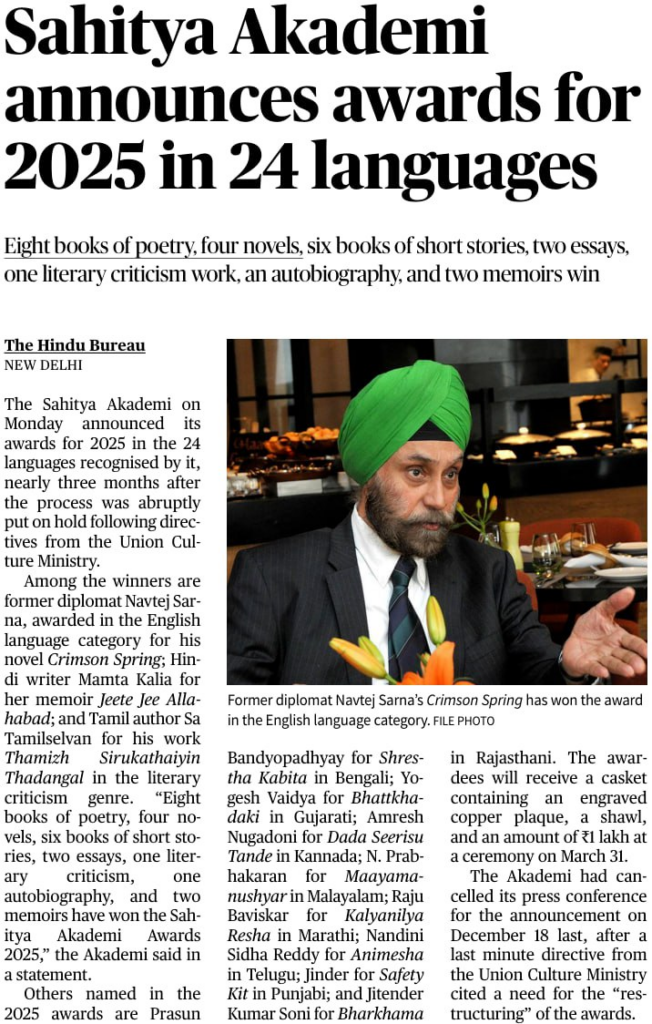
The Sahitya Akademi has officially announced its prestigious literary awards for 2025 across 24 languages. The announcement is particularly newsworthy because it comes nearly three months after the process was abruptly halted following a directive from the Union Culture Ministry, which cited a need for the “restructuring” of the awards.
Background
- The Institution: The Sahitya Akademi (India’s National Academy of Letters) is the country’s central literary body, and its annual awards are among the highest recognitions for Indian writers.
- The Delay: The award process was originally scheduled for an announcement in December 2024. However, a last-minute directive from the Union Culture Ministry led to the cancellation of the press conference, putting the entire process on hold for several months.
- The 2025 Awards: Despite the delay, the Akademi has now named the winners in 24 languages. The list includes works in various genres, with eight books of poetry, four novels, six books of short stories, two essays, one work of literary criticism, one autobiography, and two memoirs being recognized.
Feature
The 2025 list features a diverse range of established and celebrated authors:
- English: Former diplomat Navtej Sarna won for his novel Crimson Spring.
- Hindi: Renowned writer Mamta Kalia was awarded for her memoir Jeete Jee Allahabad.
- Tamil: Sa Tamilselvan won in the literary criticism category for Thamizh Sirukathaiyin Thadangal.
Other Languages:
- Prasun Bandyopadhyay (Bengali) for Shrestha Kabita.
- Yogesh Vaidya (Gujarati) for Bhattkhadaki.
- Amresh Nugadoni (Kannada) for Dada Seerisu Tande.
- N. Prabhakaran (Malayalam) for Maayamanushyar.
- Raju Baviskar (Marathi) for Kalyanilya Resha.
- Jinder (Punjabi) for Safety Kit.
- Jitender Kumar Soni (Rajasthani) for Bharkhama.
Challenge
The central challenge highlighted by this news is the tension between institutional autonomy and government oversight. The three-month delay caused by the Ministry’s intervention raises questions about the independence of cultural and literary bodies in India. The abrupt halt to the process created uncertainty for writers and raised concerns within the literary community about potential censorship or pressure, even though the awards were eventually announced without any reported changes to the selections.
Way Forward
- Clarity on “Restructuring”: To prevent future controversies, the government and the Akademi need to provide clarity on what the proposed “restructuring” of the awards entails and whether it will affect future selections.
- Rebuilding Trust: The Akademi must work to reassure the literary community that the award process remains free, fair, and independent of external pressures.
- Smooth Conduct of Ceremony: The immediate way forward is the successful conduct of the awards ceremony on March 31, where the winners will be felicitated with a copper plaque, a shawl, and a cash prize of ₹1 lakh.
Conclusion
The announcement of the Sahitya Akademi Awards 2025 brings a sense of resolution to a period of uncertainty. While the literary world celebrates the deserving winners, including Navtej Sarna and Mamta Kalia, the controversy surrounding the delay serves as a reminder of the delicate balance between government administration and the autonomy of cultural institutions. The event on March 31 will not only honor literary excellence but also hopefully mark the restoration of normalcy to one of India’s most important literary traditions.