Crab in Silent Valley Shows Both Male and Female Traits
Why in the News?
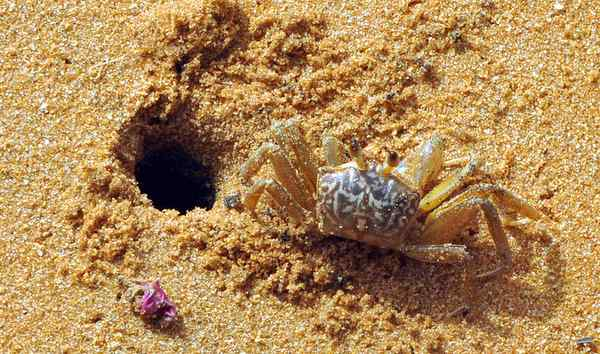
A tiny freshwater crab discovered in Kerala’s Silent Valley National Park has made news because it is a gynandromorph, meaning it exhibits both male and female biological traits simultaneously. This condition has never before been reported in the Gecarcinucidae family of freshwater crabs, making it a first-of-its-kind discovery for this group. The findings have been published in the international journal Crustaceana.
Background
- The Species: The crab belongs to Vela carli, an endemic freshwater crab species found exclusively in the forests and streams of the Central Western Ghats.
- The Phenomenon: The condition is known as gynandromorphy, a rare biological phenomenon where an organism displays both male and female physical characteristics. In these crabs, the body exhibited male reproductive structures alongside female features like gonopores (the openings for reproduction).
- The Discovery: Researchers found three crabs with this dual-sex condition living in tree holes within the Silent Valley National Park.
- The Research Team: The study was conducted by K.S. Anoop Das and K.T. Fahis from MES Mampad College, in collaboration with scientist Sameer K. Pati and Purnima Kumari from the Zoological Survey of India.
Feature
The key feature of this news is its scientific rarity. While gynandromorphy has been documented in other marine and freshwater crab families, this marks the first recorded instance in the family Gecarcinucidae. This expands the scientific understanding of developmental biology and sexual differentiation within crustaceans, highlighting that such anomalies can occur even in highly specific and evolutionarily distinct lineages like those in the Western Ghats.
Challenge
The primary scientific challenge is understanding the cause and prevalence of this condition. The discovery raises several questions:
- Is this a random genetic mutation, a developmental anomaly, or a result of environmental factors within the Silent Valley ecosystem?
- How does this condition affect the crab’s behavior, survival, and ability to reproduce?
- Are these three crabs isolated cases, or does gynandromorphy occur more frequently in Vela carli populations than previously unnoticed?
Way Forward
Moving forward, researchers will likely need to:
- Conduct Further Study: Initiate long-term monitoring of the Vela carli population in Silent Valley to determine if more gynandromorphs exist.
- Genetic Analysis: Perform detailed genetic and histological studies to understand the cellular mechanisms that caused this dual-sex development.
- Ecological Impact Assessment: Study the ecological role and breeding capabilities of these crabs to see if they contribute to the gene pool or if the condition renders them sterile.
- Habitat Protection: Continue to protect the fragile evergreen forest habitat of Silent Valley, as endemic species with rare biological traits are highly sensitive to environmental changes.
Conclusion
The discovery of a gynandromorphic crab in Silent Valley is a landmark finding for carcinology (the study of crabs) and evolutionary biology. It underscores the incredible biodiversity of the Western Ghats and proves that even in well-studied animal groups, nature can still present unique and surprising phenomena. This finding not only adds a new chapter to the study of the Gecarcinucidae family but also highlights the importance of conserving pristine habitats like Silent Valley, which continue to harbor such biological secrets.