India’s Rising Farm Exports – Growth, Trends, Global Market.
Why in the News?
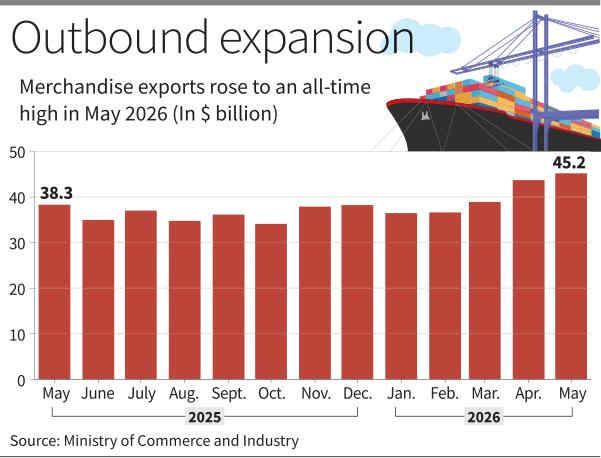
India’s agricultural exports are poised to touch a new high in 2024–25, crossing $55 billion, even as overall merchandise exports remain flat. During April–June 2025, farm exports saw a 5.84% growth year-on-year despite global uncertainties, possible U.S. tariff hikes under Donald Trump, and domestic inflation pressures.
Background

- The global food price index rose in 2022–23 due to droughts and supply disruptions, but has since eased.
- India’s agricultural trade surplus has declined from $27.7 billion in 2013–14 to $13.1 billion in 2023–24, mainly due to higher imports of edible oils, pulses, and fruits.
Feature
- Top Export Items (Apr–Jun 2025): Marine products, basmati rice, non-basmati rice, spices, buffalo meat, coffee, fruits & vegetables, and processed foods.
- Key Trends:
- Marine products ($7.4 billion projected for 2024–25) are the largest contributor.
- Rice exports are significant but could face pressure due to potential U.S. tariffs and changing demand.
- Spices, coffee, and processed foods show double-digit growth.
- Risks Ahead:
- U.S. tariffs of 50% on Indian goods starting in August could hurt exports.
- Inflationary pressures in food commodities like onions, wheat, and rice may lead to export restrictions.
- Global demand fluctuations and weather uncertainties remain concerns.
Challenge
- Tariff Uncertainty: The potential imposition of high U.S. tariffs under Trump’s policy stance may reduce competitiveness in a key market.
- Agricultural Trade Surplus Shrinking: India’s net farm exports are reducing due to rising imports of edible oils, pulses, and fruits.
- Price Volatility: Climate events, global food price swings, and domestic inflation could trigger export bans or restrictions.
- Overdependence on Few Commodities: Heavy reliance on marine products, rice, and spices makes India vulnerable to global demand shocks.
Way Forward
- Diversification of Export Basket: Encourage value-added agri products, processed food, and niche commodities to reduce dependency on a few bulk items.
- Trade Diplomacy: Proactively engage with the U.S. and other key partners to negotiate tariff relaxations or secure alternative market access.
- Boost Domestic Supply Stability: Strengthen irrigation, storage, and logistics to avoid domestic shortages that trigger export bans.
- Quality & Branding: Promote Indian agri products under global certifications and GI tags to fetch higher prices.
- Import Substitution: Develop domestic production of edible oils and pulses to reduce the agricultural trade gap.
FAQ: Flash Floods in Uttarkashi, Uttarakhand (2025)
What caused the flash floods in Dharali, Uttarkashi?
The flash floods were caused by a sudden surge in the Kheer Ganga river due to torrential rainfall in the upper reaches of Uttarkashi district. The fragile Himalayan ecosystem and intensified monsoon conditions contributed to the disaster.
How many people were affected by the floods?
At least four people died, 60–70 people were reported missing or trapped, and over 25 buildings, including homes, hotels, and shops, were destroyed. Around 120 individuals were rescued by emergency teams.
Why is Uttarakhand particularly prone to flash floods and similar disasters?
Uttarakhand is located in the fragile Himalayan region, characterised by steep slopes, narrow valleys, intense monsoon rains, climate change-induced events like cloudbursts and glacier melt, and unregulated development.
What role did human activities play in worsening the disaster?
Unplanned urbanisation, road and hotel construction near rivers, and hydropower projects have disrupted natural river flows, reduced absorption capacity, and increased vulnerability to floods.
What emergency measures were taken by the government?
Relief camps were set up, hospitals were placed on emergency alert, schools were shut, trekking permits were suspended, and the Army, ITBP, and SDRF conducted rescue operations.
How is climate change linked to flash floods in the Himalayas?
Climate change is increasing the frequency of cloudbursts and extreme rainfall, accelerating glacial melt, and making weather patterns more erratic, overwhelming existing infrastructure.
What are the main challenges in managing such disasters?
Challenges include poor early warning systems, difficult terrain, weak enforcement of regulations, and over-reliance on tourism in ecologically sensitive zones.
What steps can be taken to prevent future flash floods?
Install real-time monitoring systems, restrict construction in flood-prone zones, promote sustainable tourism, restore natural floodplains, and train disaster response teams.
What policy reforms are needed at the national level?
A national Himalayan strategy is needed, focusing on climate adaptation, sustainable development, and increased disaster resilience funding for mountain states.
Why is this event significant for India’s climate and disaster policy?
The Dharali flash floods show how climate change, poor planning, and ecological neglect can lead to disaster. They highlight the need for proactive, climate-resilient development policies.