
Centre Revamps PLFS, Includes Rural Jobs Data
The National Statistics Office (NSO) under the Ministry of Statistics and Programme Implementation (MOSPI) has revamped the Periodic Labour Force Survey (PLFS) from January 2025. The objective is to enhance the frequency, scope, and reliability of labour market indicators and to provide timely and granular employment data for policy making. Changes in the Periodic Labour Force Survey:
Recently, the Union Government has decided to revamp the Periodic Labour Force Survey (PLFS), which started in 2017, to include employment and unemployment data from rural areas. PLFS is a large-scale survey conducted by the National Statistical Office (NSO) under the Ministry of Statistics and Programme Implementation (MoSPI).
About:
PLFS was launched in 2017:
- To generate quarterly estimates of key employment and unemployment indicators for urban areas using the Current Weekly Status (CWS) approach.
- To provide annual estimates for both rural and urban areas using both Usual Status (ps+ss) and CWS approaches.
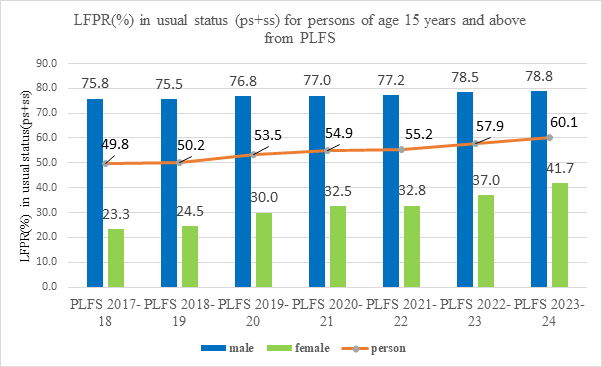
- Usual Status (ps+ss) assesses a person’s activity over the past 365 days, while Current Weekly Status (CWS) assesses it over the past 7 days before the survey.
- The National Statistical Office (NSO) under MOSPI is actively enhancing the frequency, scope, and relevance of NSS surveys.
- The revamped PLFS will now provide monthly estimates of key labour market indicators, Labour Force Participation Rate (LFPR), Worker Population Ratio (WPR), and Unemployment Rate (UR) using the Current Weekly Status (CWS) approach. First monthly bulletin (April 2025) to be released in May 2025.
- Enables timely, high-frequency policy insights.
Objective
- Its main objective is to provide reliable and timely data on:
- Employment and unemployment levels
- Labour force participation rate (LFPR)
- Worker population ratio (WPR)
- Unemployment rate (UR)
- Nature of employment (e.g., regular salaried, self-employed, casual labour)
Monthly Estimates at All-India Level
- The revamped PFLS will now provide monthly estimates of key labour market indicators, Labour Force Participation Rate (LFPR), Worker Population Ratio (WPR), and Unemployment Rate (UR) using the Current Weekly Status (CWS) approach. First monthly bulletin (April 2025) to be released in May 2025.
- Enables timely, high-frequency policy insights.

Significance
- India lacks reliable high-frequency employment data — PLFS fills that gap.
- Helps track labour market trends in real-time or near real-time.
- Used by government, economists, researchers, and international organisations like the ILO, World Bank, etc. Aids in assessing the impact of policies, economic cycles, or crises (e.g., COVID-19) on employment.
Rural Areas
- Previously limited to urban areas, quarterly estimates will now also be available for rural areas, providing a comprehensive national picture of employment and unemployment.
- First quarterly bulletin (April–June 2025) to be released in August 2025.

Shift to Calendar Year-Based Annual Reporting
- Annual PLFS results will now be aligned with the calendar year (January–December) instead of the earlier July–June cycle. Enhances consistency with international labour statistics databases. Household Income Sources: Rent from land/building; Interest from savings/investments; Pension received; Remittances received.
- Land Ownership: Land possessed, Land leased out.
- Vocational/Technical Training: Nature of certifying body. Education Details (5 new items): Years of education completed; Months attended in last academic year; Details on secondary education.
Size and Coverage
- There has been a significant increase in sample size and a shift to a panel design, with households visited four times (First with a full schedule, followed by three revisits). sample size: ~2.72 lakh households, a 2.65x increase from previous ~1.02 lakh
District-Level
- Districts are designated as primary geographical units (basic strata) in most cases.
- Improves spatial representation and reliability of labour market estimates.
- Stratification based on location (e.g., proximity to towns or cities) to better capture variations in labour dynamics
Key Changes in PLFS from January 2025

Monthly Estimates Introduced:
- For the first time, monthly estimates of key labour indicators ‘Labour Force Participation Rate (LFPR), Worker Population Ratio (WPR) and Unemployment Rate (UR)’ will be released. These are based on the Current Weekly Status (CWS) for both rural and urban areas at the all-India level.
Quarterly Estimates Extended to Rural Areas:
- From 2025, rural areas will also be included, enabling combined country-level estimates to be made quarterly. (Earlier, quarterly results were limited to urban areas.)
Annual Results Aligned to Calendar Year:
- Annual results will now follow the calendar year format (January–December), instead of the earlier July–June cycle.
- This will assist in synchronising India’s labour statistics with international databases.
Conclusion
- The revamp of the Periodic Labour Force Survey marks a significant step forward in India’s labour market data infrastructure. By introducing monthly estimates, expanding quarterly reporting to rural areas, and shifting to a calendar-year reporting format, the updated PLFS addresses previous gaps in timeliness, rural representation, and international comparability.
PRELIMS PRACTICE QUESTION
Question: What is a key change introduced in the revamped Periodic Labour Force Survey (PLFS) starting January 2025?
A) Only urban employment data will be collected.
B) Employment data will be collected once every five years
C) Monthly estimates of labour indicators will be released for both rural and urban areas
D) The survey will stop collecting unemployment data
Correct Answer: (C) Monthly estimates of labour indicators will be released for both rural and urban areas.
MAINS PRACTICE QUESTION
Question: How will the recent revamp of the Periodic Labour Force Survey (PLFS) improve the accuracy, frequency, and inclusivity of employment and unemployment data collection in India?
Also Read Education Without Employment