Food prices take retail inflation to 3.9% in May
Why in the news?
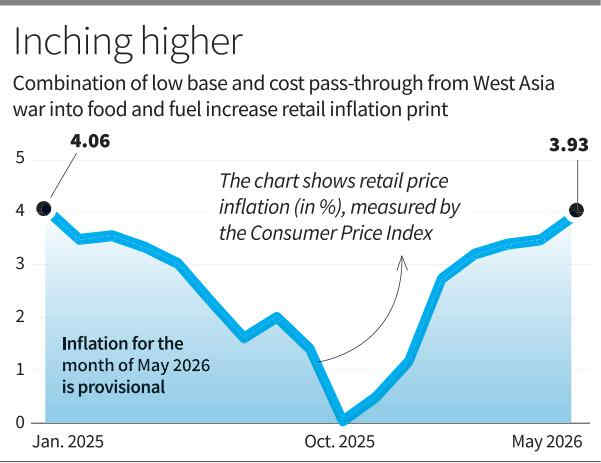
According to the Ministry of Statistics and Programme Implementation, the inflation rate in India, as measured by the Consumer Price Index, stood at 3.9% in May 2026, up from 3.5% in April 2026. This increase is mainly attributed to higher food prices, especially for cereals and vegetables such as tomatoes. The current level represents the highest retail inflation in India since January 2025.
Background
What is Inflation?
- Inflation refers to the sustained increase in the general price level of goods and services in an economy over a period of time, reducing the purchasing power of money.
Consumer Price Index (CPI)
- CPI measures changes in the prices of a basket of goods and services consumed by households.
- It is compiled by the Ministry of Statistics and Programme Implementation (MoSPI).
- The Reserve Bank of India (RBI) uses CPI inflation as the primary benchmark for monetary policy.
Inflation Targeting Framework
- 4%+-2%
- Under the RBI’s flexible inflation-targeting framework:
- Target inflation rate: 4%
- Tolerance band: 2%–6%
- The framework was adopted in 2016 following recommendations of the Urjit Patel Committee.
Composition of CPI Basket
Major components include:
| Category | Weight (%) |
| Food & Beverages | 45.86 |
| Housing | 10.07 |
| Fuel & Light | 6.84 |
| Clothing & Footwear | 6.53 |
| Miscellaneous | 28.32 |
Features
Retail Inflation Rose to 3.9%
- CPI inflation increased from 3.5% in April 2026 to 3.9% in May 2026.
- It remains within the RBI’s target range but indicates renewed price pressures.
Food Inflation Emerged as the Key Driver
- Cereals
- Cereal inflation turned positive for the first time since January 2026.
- Rice prices increased by 0.23%.
- Overall cereal prices rose by 0.28%.
Vegetables
- Tomato inflation surged sharply:
- April 2026: 35.3%
- May 2026: 48.4%
- This reflects supply-side disruptions and seasonal fluctuations.
Housing and Utilities Inflation Increased
- Inflation in:
- Housing
- Water supply
- Electricity
- Gas
- Other fuels
- rose from 1.71% to 1.73%.
- These categories account for nearly 17.6% of the retail basket, making them significant contributors to household expenditure.
Inflation Remains Below RBI’s Upper Threshold
- Despite the increase:
- Inflation remains below 4%.
- It is comfortably below the RBI’s upper tolerance limit of 6%.
- This provides some room for accommodative monetary policy if growth concerns arise.
Challenges
Dependence on Weather Conditions
- Agriculture remains heavily dependent on monsoon rainfall.
- Heat waves, floods, and droughts can disrupt supply.
Supply Chain Bottlenecks
- Inadequate storage facilities.
- Transportation inefficiencies.
- Post-harvest losses.
- These factors contribute to periodic spikes in food prices.
Volatility in Vegetable Prices
- Tomatoes, onions, and potatoes frequently experience sharp price swings.
- Seasonal supply fluctuations create inflation shocks.
Global Commodity Uncertainties
- Geopolitical tensions.
- Rising energy prices.
- Trade restrictions.
- These factors can increase domestic inflationary pressures.
Structural Agricultural Issues
- Fragmented landholdings.
- Low productivity.
- Inadequate market integration.
- Such issues hinder stable food supply and price management.
Inflation Expectations
- Continuous food price increases can lead consumers and businesses to expect higher future inflation.
- This can become self-reinforcing through wage and price adjustments.
Way Forward
Strengthen Agricultural Supply Chains
- Improve cold storage infrastructure.
- Expand warehousing facilities.
- Reduce post-harvest losses.
Promote Climate-Resilient Agriculture
- Develop drought-resistant crop varieties.
- Encourage micro-irrigation.
- Improve weather forecasting systems.
Improve Price Stabilisation Mechanisms
- Strengthen the Price Stabilisation Fund (PSF).
- Maintain strategic buffer stocks.
- Enable timely market interventions.
Reform Agricultural Marketing
- Enhance market integration through digital platforms.
- Improve farmer access to markets.
- Reduce intermediary costs.
Better Data-Driven Monitoring
- Real-time tracking of essential commodity prices.
- Early warning systems for supply disruptions.
Balanced Monetary and Fiscal Coordination
- RBI should monitor inflation expectations closely.
- Government should address supply-side bottlenecks rather than relying solely on monetary measures.
Conclusion
The increase in the level of inflation in the retail sector to 3.9% in May 2026 is a clear indication that the effect of food price changes on the country’s inflation trends continues to be felt. Despite the inflation rate staying below the target levels set by the RBI, increasing prices for cereals and vegetables point out some weaknesses in agriculture and food production in the country. Investments in agriculture and market reforms are crucial to address food inflation in India.