A mislabelling of a Supreme Court handbook
Why in the News?
In February 2026, Chief Justice of India Justice Surya Kant remarked that the Supreme Court’s Handbook on Combating Gender Stereotypes (released in 2023) was “technical” and “too Harvard-oriented,” calling for a panel to review it. This critique has sparked debate, with the author—a lawyer and legal scholar—arguing that such characterisations misrepresent the handbook’s true nature and risk undermining a significant institutional achievement.
Background
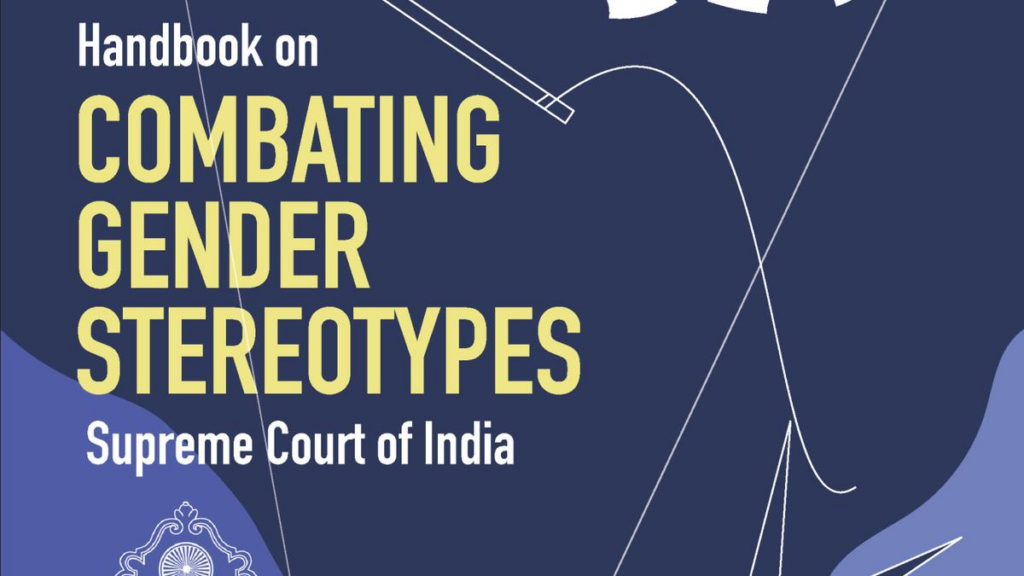
The Handbook on Combating Gender Stereotypes was released in 2023 under the CJI D.Y. Chandrachud. Its objectives were threefold:
- To identify language in judicial reasoning that perpetuates gender stereotypes and suggest alternatives.
- To highlight common reasoning patterns based on stereotypes and explain why they are legally incorrect.
- To compile binding Supreme Court precedents that have already rejected such stereotypes.
The handbook uses a tabulated format presenting stereotype-promoting language alongside recommended alternatives, supported by case law. It emerged from decades of feminist legal scholarship documenting problematic language in Indian judgments, such as using the term “keep” to describe women in live-in relationships or “ravished” to describe rape, and aligns judicial language with constitutional commitments to dignity and equality.
Challenge
- Misunderstanding the Audience: Critics, including the CJI’s remarks, suggest the handbook is too technical for survivors and laypersons. However, the author argues the handbook is explicitly addressed to judges and lawyers- professionals trained to interpret statutes and craft reasoned judgments. Technical precision is therefore appropriate, not a flaw.
- Risk of Dismissal: Labelling the handbook “Harvard-oriented” implies it is detached from Indian realities. The author contends this overlooks its firm grounding in Indian precedent and courtroom realities, as it compiles binding Indian Supreme Court decisions and addresses language patterns found in Indian judgments.
- Undermining Institutional Progress: The handbook represented a significant institutional acknowledgement that language can entrench or dismantle inequality. Dismissing it as overly academic risks diminishing this step toward internal judicial accountability.
Way Forward
- Evolve Through Feedback: The handbook should be improved based on input from the Bench, the bar, and civil society.
- Complement with Training: The emphasis on greater practical training for judges is welcome, but training should supplement, not replace, the handbook’s guidance.
- Retain Core Purpose: Any review should preserve the handbook’s essential function: providing judges and lawyers with a practical, precedent-based tool to eliminate stereotypical reasoning from judicial language.
Conclusion
The Handbook on Combating Gender Stereotypes is not a detached academic exercise but a practical, context-driven guide rooted in Indian law. To label it “Harvard-oriented” or overly technical misreads its audience and purpose. While the handbook can and should evolve, such evolution must proceed from an accurate understanding of its role: an institutional tool for judicial accountability that aligns language with constitutional values. Dismissing its significance risks setting back efforts to combat gender stereotypes within the judiciary.