India’s Trade Deficit Falls to $6.6 Billion in November on Export Growth
Why in the News ?
India’s trade deficit narrowed sharply to $6.6 billion in November 2025, a decline of over 61%, driven by strong growth in merchandise exports and a contraction in merchandise imports, according to data released by the Ministry of Commerce and Industry.

Background
- Trade deficit refers to the excess of imports over exports.
- India traditionally runs a structural trade deficit, particularly due to:
- Energy imports
- Gold imports
- Capital goods dependence
- In October 2025, concerns arose due to an 11.8% fall in merchandise exports and a spike in imports led by gold.
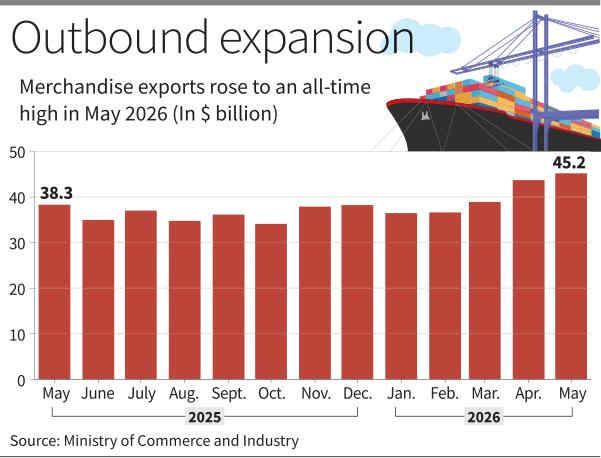
- The November data have eased these concerns, marking the highest November merchandise exports in the last 10 years.
Feature
Export Performance
- Total exports grew 15.5% to $74 billion.
- Merchandise exports rose 19.4% to $38.1 billion.
- Exports to the U.S.:
- Increased 22.6% year-on-year to $6.98 billion
- Were 10.7% higher than in October 2025
- This growth occurred despite the U.S. imposing a 50% tariff on Indian imports since August-end.
Import Trends
- Total imports declined 0.6% to $80.6 billion.
- Merchandise imports fell 1.9% to $62.7 billion.
- Gold imports:
- Fell nearly 60% year-on-year
- Declined 73% compared to October
- Reduced to $4 billion in November
Trade Balance Outcome
- The combined effect of rising exports and falling imports led to a sharp contraction in the trade deficit.0
Challenge
Sustainability of Export Growth
- Export performance remains vulnerable to:
- Global economic slowdown
- Geopolitical tensions
- Protectionist trade measures (e.g., U.S. tariffs)
Import Compression vs Structural Strength
- Reduction in imports, especially gold, may be temporary.
- A falling trade deficit driven mainly by import compression may not reflect long-term competitiveness.
External Dependence
- Continued reliance on select markets (notably the U.S.) exposes India to policy shocks.
- Tariff barriers and trade disputes can affect export momentum.
Volatility in Gold Imports
- Gold imports are influenced by:
- Domestic demand
- Global prices
- Policy measures
- Sudden surges can widen the trade deficit again.
Way Forward
Export diversification:
- Expand market access beyond traditional partners.
Value-added manufacturing:
- Strengthen initiatives like Make in India and PLI schemes.
Stable trade policy:
- Address tariff and non-tariff barriers through diplomacy and FTAs.
Reduce import dependence:
- Promote domestic production of energy, electronics, and capital goods.
Gold demand management:
- Encourage financial instruments like Sovereign Gold Bonds.
Logistics and competitiveness reforms:
- Reduce transaction costs to sustain export growth.
Conclusion
The sharp contraction in India’s trade deficit in November 2025 reflects a positive rebound in merchandise exports and a moderation in imports, particularly gold. While the data signals improved external sector health in the short term, sustaining this trend will depend on structural export competitiveness, diversified markets, and reduced import dependence, rather than temporary import compression alone.