Download Public Administration Syllabus PDF for UPSC Optional
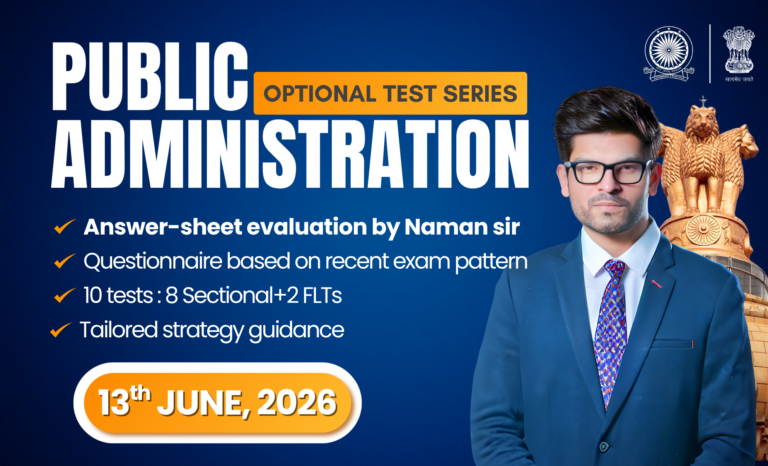
You can download the UPSC Public Administration Syllabus PDF from official sources, such as the UPSC website, or from trusted coaching platforms, such as Naman Sharma IAS Academy. The syllabus is divided into two papers:
- Paper I: Administrative Theory – covers Administrative Thought, Organisational Structure, Personnel & Financial Administration.
- Paper II: Indian Administration – includes evolution of Indian Administration, Central-State relations, Civil Services, and Law & Order.

Why Choose Public Administration for UPSC?
Stuck picking an optional subject? Choose Public Administration – the tried-and-tested favourite of countless UPSC toppers.
Why does it work? Overlap. About 40-50% of the Public Administration syllabus overlaps directly with GS Paper-II (Polity) and GS Paper-IV (Ethics). Learn once, score twice.
The updated syllabus focuses on contemporary themes like E-governance, RTI, and Social Audit – topics frequently seen in both Prelims and Mains.
Quick Strategy:
- Download the PDF and highlight overlapping topics with GS.
- Use standard books like Laxmikanth for Indian Administration and Fadia for Theory.
- Link every concept with current examples.
Make the smart choice. Public Administration isn’t just theory – it’s the blueprint of how India runs. Start today!.
About FAQ: Public Administration Syllabus PDF
Does the Public Administration syllabus change frequently?
The core structure remains stable, but UPSC occasionally updates topics (e.g., adding e-governance, RTI, citizen charter). Always refer to the latest year’s notification
Can I get the syllabus for BA/MA Public Administration?
Yes. Universities like DU, IGNOU, Pune University, and Allahabad University publish their semester-wise syllabus PDFs on their official websites.
Is the syllabus enough to prepare, or do I need additional books?
The syllabus is your roadmap. You’ll need standard books like Laxmikanth (Indian Administration), Fadia & Fadia (Administrative Theory), and Mohit Bhatt to cover it thoroughly